
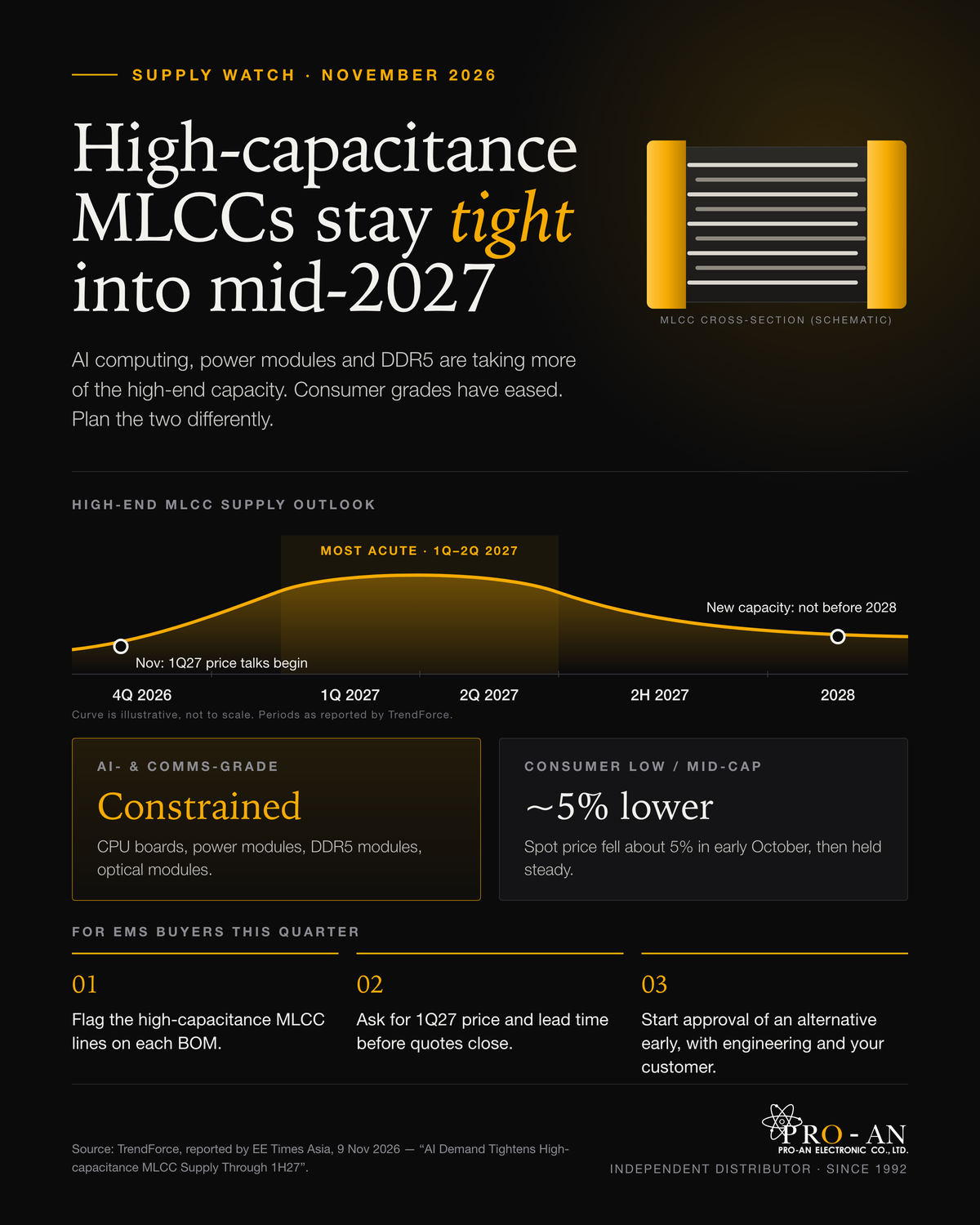
High-capacitance MLCCs: tight into mid-2027. Consumer grades: easing. Plan the two differently.
On 9 November EE Times Asia reported TrendForce's latest view on the MLCC market. The short version for anyone buying for an EMS line:
• Demand for high-capacitance MLCCs is rising with AI computing. More CPUs mean more power modules and DDR5 memory, and both use high-capacitance MLCCs.
• TrendForce expects the high-end shortage to be most acute in the first and second quarters of 2027, and to last through the first half of 2027.
• Supply is also tight for communications-grade MLCCs used in optical modules.
• Murata has said its current capacity is not enough. The added capacity is not expected to run before 2028.
• Talks on first-quarter 2027 pricing start this month.
• At the other end, spot prices for low- and mid-capacitance consumer-grade MLCCs fell about 5% in early October, then held steady.
So one BOM can hold two different markets. What that means in practice:
1. Flag the high-capacitance MLCC lines on each BOM. These are the ones to watch, not the whole passive list.
2. Ask for first-quarter 2027 price and lead time on those lines now, while the talks are open.
3. If a line has a single approved source, start approving an alternative early. That approval sits with your engineering team and your customer, and it takes longer than a purchase order.
If you want a second quote on a high-capacitance line, send us the full part number, quantity and required date. Pro-An, an independent distributor established in Hong Kong in 1992, with offices in Hong Kong and Shenzhen, will reply with what we can source and the lead time quoted for it.
#EMS #Procurement #MLCC #PassiveComponents #SupplyChain
Source: EE Times Asia, 9 November 2026, TrendForce
Images